
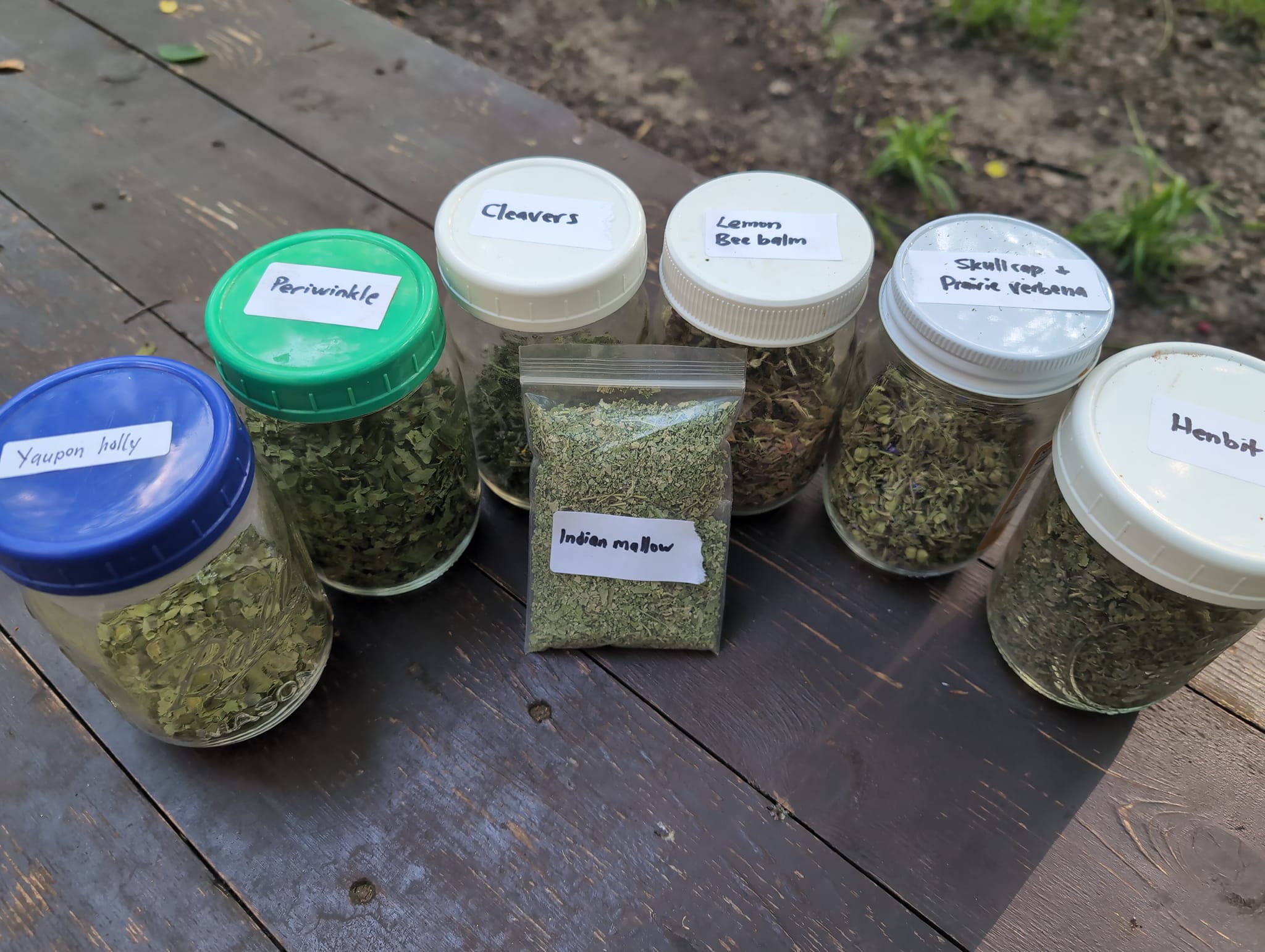
One of my favorite easy ways to get more wild plants into my body consistently is to harvest and dry various wild medicinal and nutritive leaves and flowers, and use them to make herbal tea.
Decades ago, I learned from herbalist Susun Weed that some wild plants are both densely nutritive and medicinally useful, and can be made into what she calls a nourishing herbal infusion. It’s similar to an herbal tea, but using much more plant material, and the purpose is to provide significant quantities of essential nutrients to the body, sometimes even as a multivitamin replacement. Making these concentrated herbal infusions became routine for me, especially during my two pregnancies, postpartum, and nursing times, when getting enough nutrients is vitally important. They are hydrating, nourishing and mineralizing. Stinging nettle leaf (Urtica dioica) has always been my staple tea herb, and I usually purchase it in bulk, since nettle unfortunately does not grow in abundance in my area. If I lived somewhere with lots of wild nettle, I would be harvesting my own regularly! Nettle leaf infusions increase energy and stamina, strengthen the kidneys and adrenals, reduce allergies, improve skin and hair health, and provide a full spectrum of macro and trace minerals, vitamins, and even protein.
I still drink a lot of nettle leaf tea, but usually not in the concentrated amounts I used to, and now I most commonly use it as a base to mix with other wild herbs, since it has a mild flavor.

In the spring and summer in Texas, I take advantage of the peak growth stages of our local medicinal herbaceous plant species, and harvest them before or during the flowering stage. For most medicinal plants, both the greens and flowers can be used.
Some of my favorite local medicinal and/or nutritive plants to harvest for tea include:
- Prairie verbena / mock vervain (Glandularia bipinnatifida)
- Cleavers (Galium aparine)
- Henbit & purple deadnettle (Lamium amplexicaule & L. purpureum)
- Beebalm/horsemint (Monarda citriodora, M. punctata and others)
- Wild skullcap (Scutellaria drummondii)
- Mullein (Verbascum thapsus)
- Yaupon holly (Ilex vomitoria)
- Japanese honeysuckle leaf (Lonicera japonica)
- Goldenrod (Solidago spp.)
- Giant ragweed (Ambrosia trifida)
- Mugwort (Artemesia ludoviciana & others)
- Oatstraw/oat grass (Avena spp.)
- Mulberry leaf (Morus alba & M. rubra)
- Hackberry leaf (Celtis laevigata)
There many other plants that can be used to make herbal tea, so this list is just the beginning! However, the above species are very common and abundant in Texas, so I consider them staples.

Here is a little bit more about each of these plants and their potential health benefits:
Prairie verbena: relaxes nervous system, sleep aid, nervine but not sedative (can drink anytime of day), relaxes neck and shoulder tension, pain relief and recovery aid
Cleavers: rich in chlorophyll, premier spring tonic, blood purifier, promotes lymphatic circulation, anti-inflammatory, diuretic, cleanses metabolic waste, can assist in resolving urinary tract infections (UTIs) and kidney inflammation
Henbit & purple deadnettle: nutritive (contains protein, calcium, potassium, phosphorus, iron, vitamins A/C/K), anti-inflammatory, relieves chronic pain/soreness/stiffness, diuretic, anti-histamine, boosts energy levels
Beebalm/horsemint: powerful antimicrobial, antiseptic, antiviral, anesthetic; relieves colds and sore throats, calming to nerves, regulates menses, can assist in resolving UTIs
Wild skullcap: cooling sedative and nervine, very bitter, relaxes muscle tension, relieves nerve pain, sleep aid/helps with insomnia, antispasmodic, antidepressant and anxiolytic (relieves anxiety)
Mullein: soothes lung inflammation & reduces infection, strengthens immune system, relieves chest constriction
Yaupon holly: contains caffeine & theobromine (the only plant native to North America containing notable amounts), high in antioxidants, rutin & chlorogenic acid, cardiovascular health (rutin strengthens capillaries), boosts metabolism
Japanese honeysuckle: powerful and unique antimicrobial and broad spectrum antiviral properties defend against bacterial infections including staph, strep, e. coli, cholera, salmonella, pneumonia, meningitis, and viral infections including influenza, common colds and covid-19 (studies on loniflavone from Japanese honeysuckle linked here and here); contains antioxidants, essential oils and the anti-histamine compound quercetin; anti-inflammatory and immune supportive
Goldenrod: astringent and aromatic; relieves allergies/hay fever (contains the anti-histamine quercetin), supports kidneys, relieves arthritis discomfort and joint pain, anti-inflammatory for kidneys (do not use with kidney stones, only after they pass), relieves coughs, colds and flu
Giant ragweed (leaf): alleviates allergies and hay fever caused by ragweed itself (and other allergens), antibacterial, antiviral, contains the anti-histamine quercetin
Mugwort: gentle aromatic bitter that supports liver and digestive health, reduces musculoskeletal and nervous tension, regulates menses, relieves GI tract inflammation (gas and cramping), improves appetite, antiviral; reduces allergies, headache and anxiety
Oatstraw / oat grass: nervous system strengthener, nutritive (contains calcium, magnesium, silica, iron and various vitamins), restorative for tired and depleted states; nourishes bones and adrenals
Mulberry leaf: used in folk medicine as a tea for diabetes, high blood pressure and high cholesterol; antibacterial, anti-inflammatory, antioxidant, supports cardiovascular system, contains resveratrol
Hackberry leaf: delicious and nutrient rich, digestive aid, relaxes musculature, high in antioxidants


Generally, I harvest these plants before or during their flowering stage, when the plant’s energy and nutrients are most concentrated in the leaves and/or flowers. I use scissors or a knife to harvest the plants I’m going to need, always only taking from abundant populations of that particular species (and only a small percentage of what’s there). If it’s considered an invasive species (like Japanese honeysuckle), then any amount is okay.
The only plant in this list that’s an exception to the above timing is the yaupon holly shrub, which is an evergreen, so its leaves can be harvested anytime of the year. However, it’s easiest to harvest yaupon leaves when the flowers and berries are not present on the tree, otherwise you’ll have to pick out stray flowers and berries from your harvest, which are not considered a medicinally usable part (even somewhat toxic in the case of the berries).
To dry the plants, you can either hang them up in a cool and dry room, place them inside a paper bag (my preferred method at this time), or lay them out flat on a screen. They should be fully dry in 1 to 3 weeks, depending on the plant, and the humidity level and temperature of the room.
When my plants are dry, I strip off the leaves and flowers from the stems (unless I dried the leaves/flowers without the stems attached). Then you need to get them into small pieces to make an ideal tea; sometimes crushing the plant material in your hand or through a strainer works, and sometimes a coffee grinder, blender or food processor is ideal. Just don’t blend it too much, as you want it to be small pieces, and not powder (unless you’re making a wild “green powder”!)


Most often, I brew a whole quart of tea at one time, since I drink a lot of herbal tea and share it with my family. I heat up a quart of pure water, add the herbs to a quart mason jar, pour boiling water on the herbs to fill up the jar, then seal it with a lid. Most of the time I let this sit for a few hours, to extract as much as possible from the herbs. This steeping time seems to work well for most herbs, but more bitter herbs like skullcap do better with a shorter steeping time (10 minutes is good).
After it steeps for a few hours and cools down, I pour it all through a fine mesh strainer bag into another container (to remove the solids), squeeze all the liquid from the strainer bag, then store it in the original jar and sip on it throughout the day. Stored in the fridge, the tea should stay good for 2-3 days, but we drink it quickly around here!
Once again, yaupon is an exception; I steep it in the morning, and just for 10 minutes. I drink it as an occasional replacement for coffee, since it contains similar amounts of caffeine (slightly less, in my experience). However, unlike green and black tea, yaupon does not contain tannins, so steeping it for longer won’t mess up the flavor and is totally okay to do!
Here are some ratios of various herbs, which are similar to the teas I make regularly:
2 tablespoons (Tbs) nettle leaf, 1 Tbs cleavers, 1 Tbs lemon beebalm in 1 quart of water (this is the one I’m drinking today)
2 Tbs prairie verbena and 1 Tbs wild skullcap in 1 quart of water (this is a great recipe for a bedtime tea that can be sipped at night and saved in the fridge for the following nights)
1 Tbs yaupon holly in 16 ounces of water (you can make a second brew with the same herbs with another pint of water afterward, in this instance)

As I’m writing this, it’s mid May, which is within the peak time of the year to harvest wild herbs! Be sure that when you’re harvesting any plant with the intention of consuming it, that you’ve identified it properly as an edible/medicinal species.
If you want to learn foraging hands-on, to skyrocket your foraging knowledge and experience level (including how to identify our local medicinal species that can be used for herbal teas), I have two more foraging classes coming up this spring that still have spaces available! Click the links below for more details and to sign up for a class:
Foraging Class – High Hope Ranch in Glen Rose, Texas – Sunday, May 19th
Foraging Class – White Rock Lake in Dallas, Texas – May 25th
Let’s get outside and enjoy this beautiful spring!


Leave a Reply to trinaleeakCancel reply