
It’s still late winter, but it feels like spring, and wild greens are popping up everywhere. I just had my first cup of cleavers juice of the year, which feels like a signal to my body that spring is truly here! I want to share details about the plant called cleavers, how to identify it, and its edible and medicinal uses.
Cleavers is the most widely used common name for Galium aparine, an herbaceous plant in the madder/coffee family (Rubiaceae). It’s such a distinctive plant that it actually has dozens of other common names: bedstraw, sticky weed, sticky willy, turkey tangle, velcro plant, goose grass, stick tights, and quite a few more. If you have it in your yard, you have certainly noticed it, and probably have a name for it.
The plant is bright green, grows quickly in late winter and early spring, and dies back soon after going to seed in the late spring or summer. It often grows in dense mats, because the plant itself has fine hairs that stick to clothing, hair and other plants, like velcro. It’s one of the easiest plants to harvest in large quantities without a foraging bag, since every clump you harvest easily sticks to your main clump, and you can come home with a very large clump in one hand. Here’s a photo of one of my big cleavers harvests in mid March of last year:

I saved about half of this in the fridge to make fresh juice over the following week, and hung the rest to air dry, to be used to make herbal tea for the rest of the year.
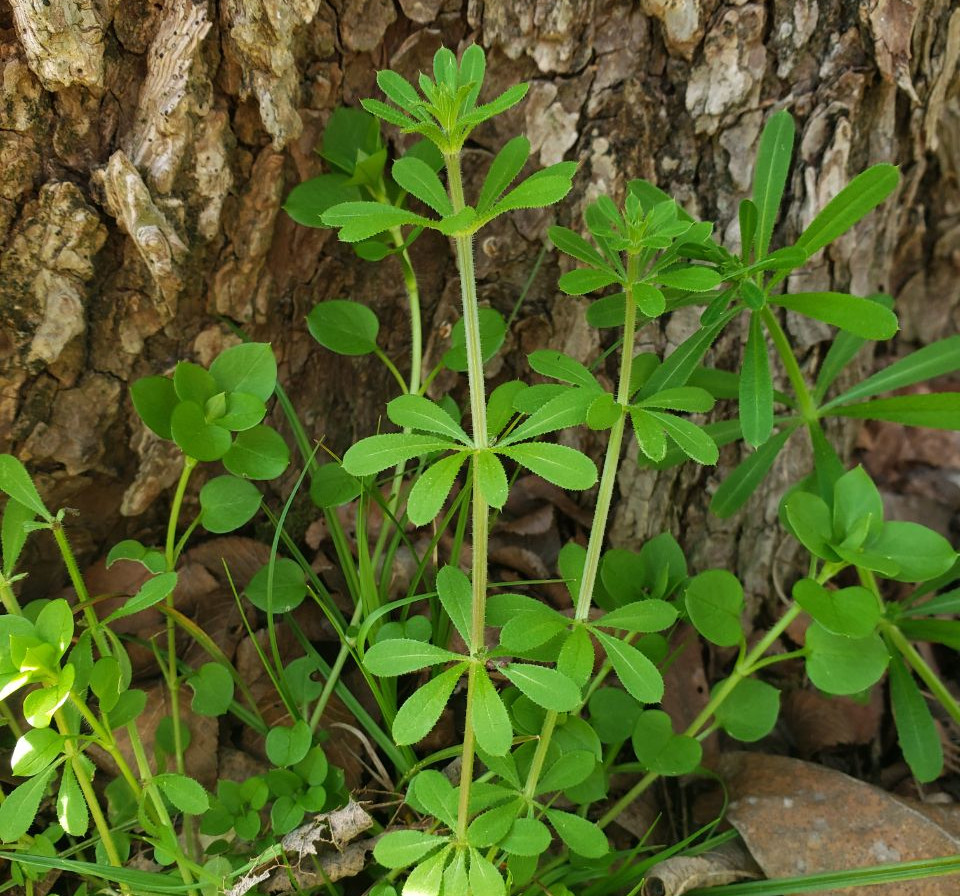
If you examine the plant closely, you will notice that the stem is square in cross section, with a hollow inside. The leaves grow in a “whorled” pattern, which means each of the narrow leaflets grow from the same node on the stem, fanning all the way around in a circular fashion. Leaves grow from several nodes along the stem, all in this whorled pattern of about 4 to 9 leaflets per node. The stickiest part of the plant is the underside of the leaves, and the stems. The top sides of the leaves are not as sticky. Sometime in the spring, white, four-petaled flowers will emerge, which turn into tiny furry balls (the seeds) by summertime. The plant dies back soon after the seeds mature. Apparently the mature seeds can be winnowed and used as a coffee substitute (since they’re in the same family), but it’s a time consuming task and they may only contain a negligible caffeine content, if any at all.
The plants have a shallow root system, so are very easy to pull up by the root. If you’re trying to get rid of large quantities of the plant, you can pull it up by the roots, but when you’re harvesting it for edible or medicinal use, I recommend just using the above ground portion of the plant, for the best flavor and texture.
Here’s a photo of young cleavers I took today (March 4th), which is a great stage for beginning to harvest them for juice, smoothies and tea:

The middle plants with the whorled leaves are cleavers, but you will also see some edible chickweed in this photo, off to the side. Both plants go in my smoothies!
Usually I will wait until the plants are much larger and more mature before I make a big harvest to preserve for later. They can reach several feet long, and when they get bigger, they’ll fall over and grow in mats. This is a very good time to harvest large clumps to preserve.
My favorite ways to preserve this short lived spring green are drying them for tea, making juice to freeze into “green juice cubes” for later use, and making into an herbal tincture. Last year, I dried so much cleavers that I was able to use the tea regularly up until early winter before running out! It’s such an abundant and nutritious plant with excellent medicinal properties that there’s no reason not to harvest and use large quantities of it, if your body responds well to it.
Today, I collected a handful of young cleavers to make juice, which I used as a liquid base for my Wild Green Smoothie recipe, which combines fruits like banana and blueberries, with other wild greens like chickweed, dandelion and henbit. Click the recipe name for a link to the recipe!
Juicing it is easy, even if you don’t have a juicer. I use a blender instead, and blend about a handful of fresh cleavers with one cup of water, then strain it through a fine mesh cheesecloth or nut milk bag. This makes a green liquid you can drink straight, or use as a smoothie base:

If you drink it by itself, it’s mild and grassy flavored, kind of like wheat grass or lettuce juice. If you’re not a fan of this type of flavor, you can make it taste better by blending the greens with apple juice instead of water, making an apple-cleavers juice instead. Or you can use it as a base for a fruit smoothie, and you will barely taste it at all.
To preserve larger quantities of the juice to use later, you can blend a quart of cleavers with a quart of water, strain it, then pour the juice into ice cube trays. When the cubes are frozen, pop them out and store them in a ziplock bag in the freezer, and throw a few into a smoothie or juice whenever you feel like it.
To dry cleavers to make tea, harvest a large quantity and place them loosely in a paper bag, or tie clumps of them together and hang them up in a cool, dry place. They should dry fully in a couple of weeks, and at that time I will chop or grind the dry cleavers into small pieces ideal for brewing herbal teas. A good ratio for a cup of tea is 1 teaspoon of dried cleavers in 1 cup of tea, or you can mix it with other herbs.
Another way to use cleavers medicinally is to make a medicinal tincture with alcohol. You can use the fresh plant, chopped small. Loosely fill any size jar with the plant material, then pour vodka or another strong alcohol over the plant material until it’s covered. It’s best to make sure you use an appropriate sized jar for the amount of tincture you want to make, and if you’re just starting out, an 8-ounce canning jar should be plenty. Let the tincture sit for 6-8 weeks, and shake the jar as often as you think of it, daily if possible. After that time, you can pour the liquid through a fine mesh strainer to remove the plant material, leaving behind a bright green vodka. You can then carefully pour the tincture through a small funnel into a dropper bottle, for ease of use. I usually take 1-2 droppers at a time of the wild herbal tinctures I make, maybe once or twice daily.
So what are the medicinal uses of cleavers? They are an excellent spring cleansing tonic and a gentle diuretic, which over time can slowly remove toxins and stagnation from the lymphatic system, kidneys, bladder and liver. They are also anti-inflammatory, so can be a mild pain reliever. Cleavers tea can also be used topically for irritated skin, wounds and poison ivy rashes, and as a hair wash.
Many people believe that edible and medicinal plants grow at the times of the year that it’s most beneficial for us to consume them, and around the living spaces of those who need them most. The cold of the winter contracts our bodies, and metabolic and other types of waste can build up during that time, as we are likely eating richer food and are less physically active. In the spring, nature wants us to get up and move, and warms up our bodies so we can release built up waste products. Herbs with cleansing and diuretic properties can assist in this process, optimizing our health and energy levels as we move into the more energetic and productive seasons of the year.
If you’ve never tried cleavers before, as with all new plants, you will want to experiment with small amounts at first. Not everyone responds well to all plants, and some people may need time to acclimate to them, so it’s best to go slow to see how your body responds. You can start with a small amount of strained juice, or one sprig of young cleavers in a smoothie with other familiar foods, and build up from there. Also, some people have a mild to moderate contact dermatitis response on their skin from touching and harvesting the plants, so pay attention to how your body responds while physically interacting with the plant, as well. I’ve personally never had any issues with cleavers, besides some mild, short lived itching if I walk through a large patch with bare legs.


Leave a Reply to Bonnie J DelpCancel reply